
Project Overview – PF22000
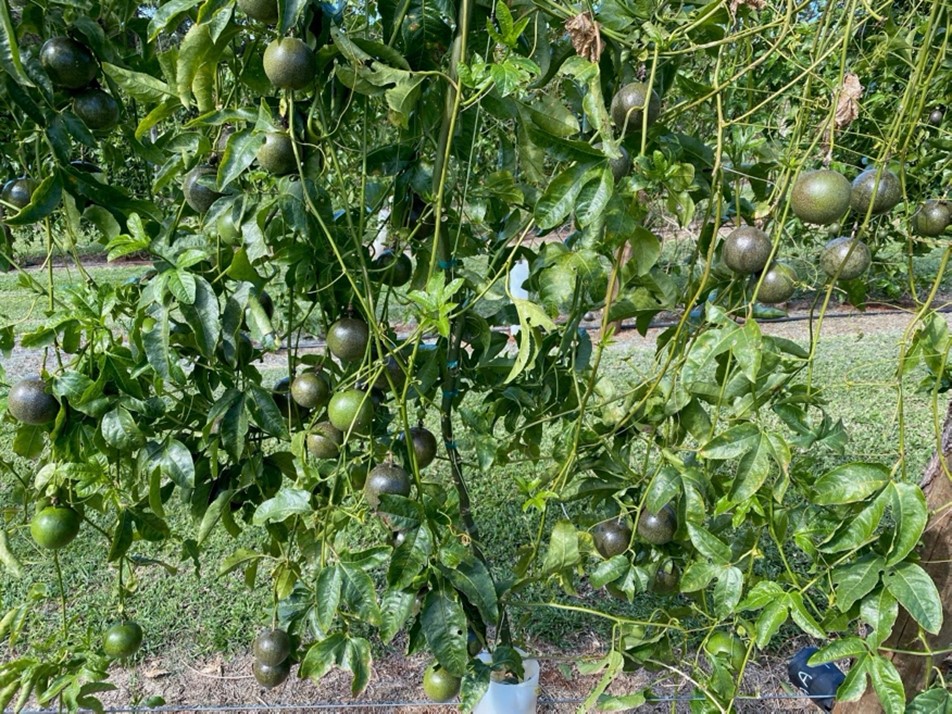
The next phase of the National Passionfruit Breeding and Evaluation Program has been contracted to continue breeding research to deliver new varieties for Australian growers.
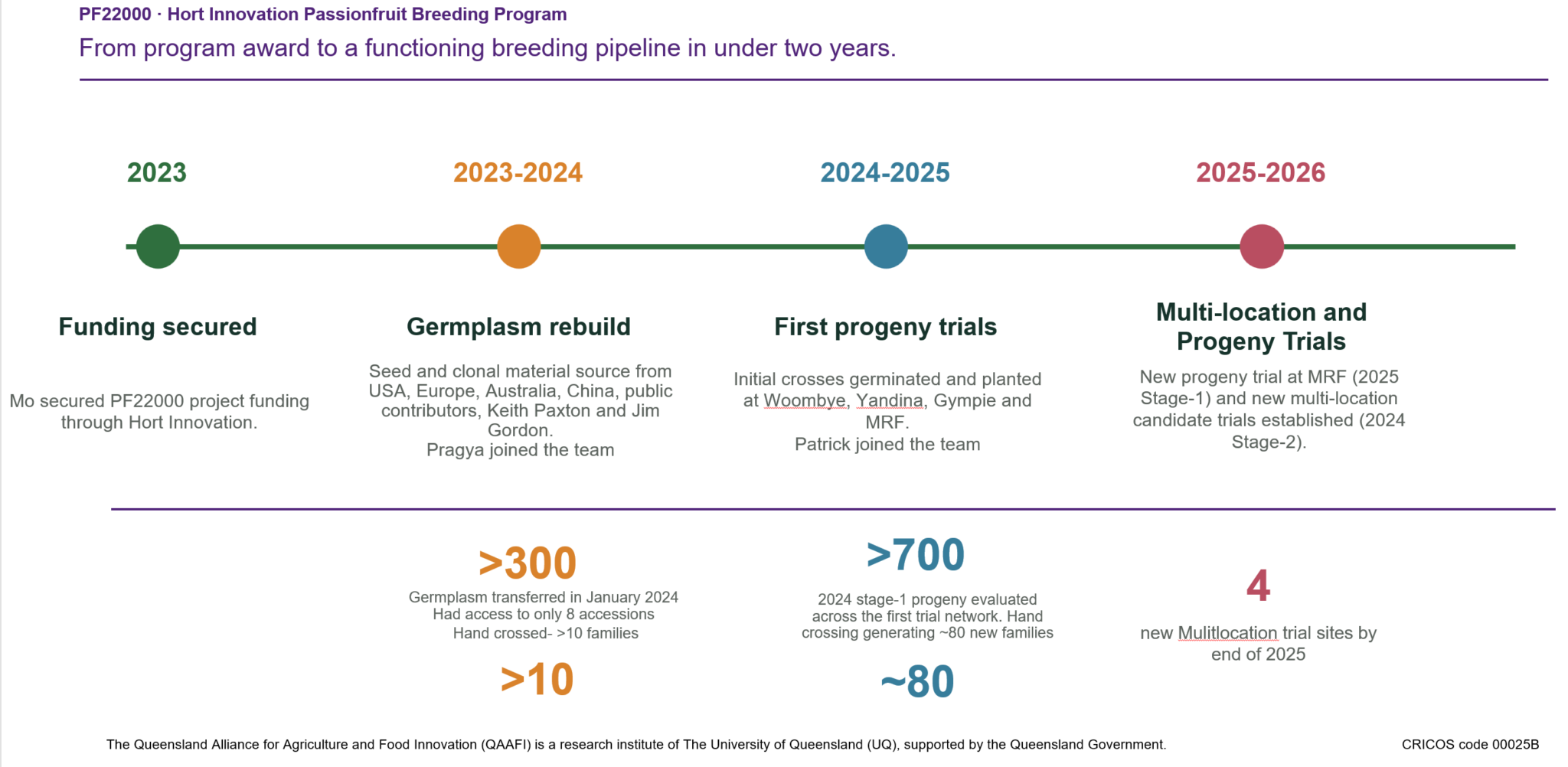
The program has been led by Dr Mobasher Alam and a research team at University of Queensland since 2023. The new 3-year project is funded by Hort Innovation using the passionfruit research and development levy, and funds from the Australian Government, and supported by contributions from University of Queensland.
As most of you will know, the main scion varieties of passionfruit grown in Australia – Sweetheart and Misty Gem – have been propagated by tip cuttings for some years and a number of problems have been reported including reduced fruit size and yield compared to the original selections, more frequent blind-tipping and also problems with finding suitable tips for grafting due to thinner tips.
The new project will continue and expand on the first phase of the breeding program building on the expertise and resources developed over the past four years.
As part of this new phase, the project will continue to engage with growers through field walks, presentations, industry news articles, and will seek input from a project reference group of growers to steer priorities towards grower needs.
Meet the Team
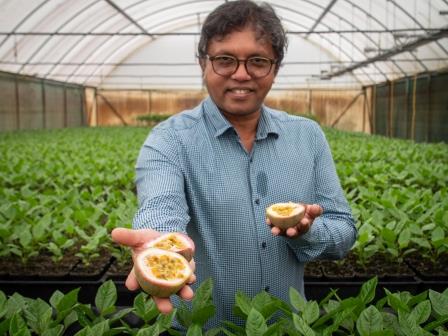
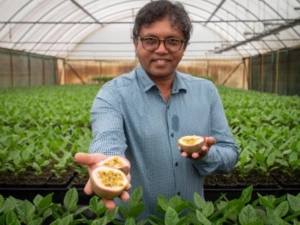
Dr Mobashwer Alam
Dr Mobashwer Alam is a Senior Research Fellow at the Centre for Horticultural Science, a theme leader of Predictive Agriculture for Improved Productivity and Value, an Advance Queensland Industry Fellow, and the team leader of the National Passionfruit Breeding and Evaluation Program (PF22000) at the Queensland Alliance for Agriculture and Food Innovation, UQ. He is currently based at Maroochy Research Station, Nambour, QLD 4560, Sunshine Coast. He has more than twenty years of research and teaching experience in the public and private industries and in universities in Australia and Bangladesh. Dr Alam has experience in multi-disciplinary research, including plant breeding, quantitative genetics, genomics, plant physiology, and crop modelling. Before joining at QAAFI, Dr Alam had been working as a Senior Plant Breeder (Grain Sorghum) at Nuseed Pty Ltd. He achieved his PhD in plant molecular genetics through the School of Agriculture and Food Sciences of the University of Queensland. Before coming in Australia in 2008, Dr Alam had been working as a lecturer and assistant professor of the Department of Genetics and Plant Breeding at Patuakhali Science and Technology University in Bangladesh. Throughout his academic and research career, he worked on multiple crops, including Macadamia, Passionfruit, Stone Fruits, Sorghum, Sugarcane, Lablab Bean, Tomato, Okra, and Ash Gourd. He is interested in developing rapid breeding tools and utilizing plant genomics in horticultural crop improvement.
View Full University of Queensland Profile HERE

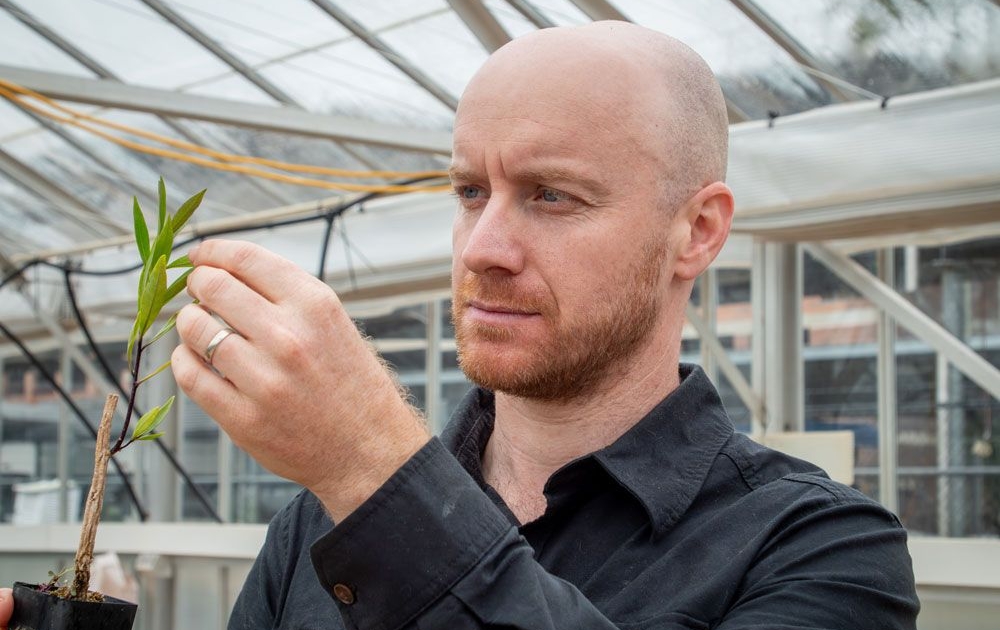
Dr Patrick Mason
Dr Patrick Mason is a Research Fellow with the Queensland Alliance for Agriculture and Food Innovation (QAAFI) at The University of Queensland. He specialises in the genetic improvement of tropical and subtropical crops, with a strong focus on crop breeding and genetic innovation to improve productivity, fruit quality, resilience and sustainability.
Dr Mason holds a Master of Agricultural Studies and a Doctor of Philosophy (PhD) from The University of Queensland. His research combines genomic and phenotypic data to develop high-performing crop varieties tailored to industry needs, supporting sustainable agricultural production. His work spans several important horticultural crops, including passionfruit, macadamia and duboisia.
As a key researcher in the National Passionfruit Breeding and Evaluation Program, Dr Mason works closely with growers and industry partners to evaluate and develop improved passionfruit varieties with enhanced flavour, quality, yield and disease resilience. His research is helping to deliver innovative, commercially viable varieties that will strengthen the long-term sustainability and profitability of Australia’s passionfruit industry.
This version is suitable for a staff profile on the Passionfruit Australia website or in industry publications.
Overview of the Plan
The primary objectives of this new project are to:
- Generate new progenies for the development of new passionfruit selections with improved agronomic performance, product quality, and consumer appeal
- Develop hybrid varieties for industry adoption
- Develop and apply new technologies and methods to enable rapid breeding
- Generate comparative performance data for progenies
- Communicate performance of new selections and varieties to the Australian passionfruit industry
With input from the research team, this project seeks to focus on developing new passionfruit varieties for the industry, considering production requirements, consumer preferences and quality and pest and disease tolerances.
Dr Alam will also investigate the potential value of accessing passionfruit genetics from breeding programs overseas to feed into the Australian passionfruit breeding program.
The current breeding program is funded through until the end of 2027 and Dr Alam will use a range of approaches to improve the chances of successfully identifying superior passionfruit selections, including efficient breeding strategies, bioeconomic and choice preference models, development of molecular markers for productivity and quality traits and a genomic selection model for yield.
A germplasm collection will also be established to feed into breeding efforts. Each year, progeny will be developed and assessed for performance.
The project will work with industry representatives and also include grower-based trials for promising selections to be evaluated in the field under different production conditions.
Meet the Team
Dr Mobashwer Alam
Dr Mobashwer Alam is a Senior Research Fellow at the Centre for Horticultural Science, a theme leader of Predictive Agriculture for Improved Productivity and Value, an Advance Queensland Industry Fellow, and the team leader of the National Passionfruit Breeding and Evaluation Program (PF22000) at the Queensland Alliance for Agriculture and Food Innovation, UQ. He is currently based at Maroochy Research Station, Nambour, QLD 4560, Sunshine Coast. He has more than twenty years of research and teaching experience in the public and private industries and in universities in Australia and Bangladesh. Dr Alam has experience in multi-disciplinary research, including plant breeding, quantitative genetics, genomics, plant physiology, and crop modelling. Before joining at QAAFI, Dr Alam had been working as a Senior Plant Breeder (Grain Sorghum) at Nuseed Pty Ltd. He achieved his PhD in plant molecular genetics through the School of Agriculture and Food Sciences of the University of Queensland. Before coming in Australia in 2008, Dr Alam had been working as a lecturer and assistant professor of the Department of Genetics and Plant Breeding at Patuakhali Science and Technology University in Bangladesh. Throughout his academic and research career, he worked on multiple crops, including Macadamia, Passionfruit, Stone Fruits, Sorghum, Sugarcane, Lablab Bean, Tomato, Okra, and Ash Gourd. He is interested in developing rapid breeding tools and utilizing plant genomics in horticultural crop improvement.
View Full University of Queensland Profile HERE
Dr Patrick Mason
Dr Patrick Mason is a Research Fellow with the Queensland Alliance for Agriculture and Food Innovation (QAAFI) at The University of Queensland. He specialises in the genetic improvement of tropical and subtropical crops, with a strong focus on crop breeding and genetic innovation to improve productivity, fruit quality, resilience and sustainability.
Dr Mason holds a Master of Agricultural Studies and a Doctor of Philosophy (PhD) from The University of Queensland. His research combines genomic and phenotypic data to develop high-performing crop varieties tailored to industry needs, supporting sustainable agricultural production. His work spans several important horticultural crops, including passionfruit, macadamia and duboisia.
As a key researcher in the National Passionfruit Breeding and Evaluation Program, Dr Mason works closely with growers and industry partners to evaluate and develop improved passionfruit varieties with enhanced flavour, quality, yield and disease resilience. His research is helping to deliver innovative, commercially viable varieties that will strengthen the long-term sustainability and profitability of Australia’s passionfruit industry.
This version is suitable for a staff profile on the Passionfruit Australia website or in industry publications.
See Dr Mason’s University Profile HERE
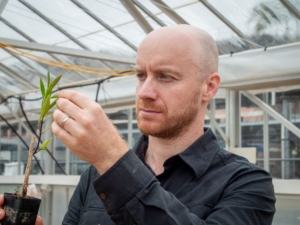
Field Day Nambour July 2026
Dr Patrick Mason gave the industry an update on breeding progress and attendees were able to taste various selections of trials. There were also spec sheets for each variety.
Access the Presentation given by Dr Patrick Mason by clicking the link below:
Powerpoint Format: Passionfruit Field_day_July_2026 updated logos
PDF Format: Passionfruit Field_day_July_2026 updated logos
Click here to add your own text
Project Overview PF19000
The next phase of the National Passionfruit Breeding and Evaluation Program has been contracted to continue breeding research to deliver new varieties for Australian growers.
The program has been led by Dr Peter Bundock and a research team at Southern Cross University since 2016. The new 5-year project is funded by Hort Innovation using the passionfruit research and development levy, and funds from the Australian Government, and supported by contributions from Southern Cross University.
As most of you will know, the main scion varieties of passionfruit grown in Australia – Sweetheart and Misty Gem – have been propagated by tip cuttings for some years and a number of problems have been reported including reduced fruit size and yield compared to the original selections, more frequent blind-tipping and also problems with finding suitable tips for grafting due to thinner tips.
The new project will continue and expand on the first phase of the breeding program building on the expertise and resources developed over the past four years. The project will concentrate mainly on scion variety breeding and aims to produce, select and evaluate new high-yielding scion varieties for Australian passionfruit growers. Some initial work aimed at producing a new Panama line will also be commenced.
As part of this new phase, the project will continue to engage with growers through field walks, presentations, industry news articles, and will seek input from a project reference group of growers to steer priorities towards grower needs.
Delivery Partner
Southern Cross University, Lismore, NSW:
The ongoing research team includes Dr Peter Bundock, Associate Professor Tobias Kretzschmar, Frances Eliott and Will Petrie. Management of the project will be transferred to Dr Cathy Nock in mid 2021 following an extended transition period to ensure the security of project data, background information, germplasm and technical expertise.
Cathy is a research fellow at Southern Cross University. She has lived in the Northern Rivers of NSW for over 25 years and her main research interest is subtropical horticulture. Cathy is a geneticist with expertise in pre-breeding and breeding research, data and project management, and germplasm conservation. She has successfully led Hort Innovation macadamia research projects and is a collaborator on the Australian macadamia breeding program.
Together, the Southern Cross University team has knowledge of the current passionfruit breeding methods and industry requirements along with a commitment to applying new methods to create new opportunities for producing passionfruit varieties into the future. Cathy is looking forward to meeting growers over the coming months and to working with the passionfruit industry.
Broad Objectives for PF19000:
Field trialling program designed to select the best performing varieties for growers.
Early-stage trial vines (1st and 2nd stage – see Breeding Cycle diagram below) will be evaluated primarily at Alstonville, with advanced selections trialled, where possible, across the three main growing regions of Northern New South Wales/South East Queensland, Wide Bay region and North Queensland.
Performance data collected for advanced material for grower information.
Production of partially inbred selections with the aim of producing a purple Panama
Maintain arboretum and expand the seed bank to preserve important germplasm
Establish a Breeding Management System for data acquisition, long-term storage and analysis
PhD student project with scholarship provided by Southern Cross University:
Determine which parent scion varieties produce the best progeny by estimating breeding values based on important traits. These best parents then used to produce larger numbers of progeny for the selection of a future variety.
Study of genetic variation for fruit shelf life.
Project Overview PF15000
Southern Cross University (SCU) is undertaking the National Passionfruit Breeding Program (PF15000) in a three year project.
During this period SCU will
1 identify candidate new scion varieties generated from bi-parental crosses;
2 establish an improved system for selecting new passionfruit cultivars for commercial production including standardised measurements from trial participants with trial and varietal information recorded in a central database;
3 obtain pre-breeding information on traits of interest such as inheritance patterns and associations with DNA markers along with the construction of a reference linkage map;
4 create additional sources of new material for future trialing by breeding new inbred lines from current material and F1 hybrids from current in-bred lines;
5 establish a seed bank to conserve and enhance current passionfruit genetic material; and
6 maintain the industry arboretum.
Delivery Partner
Southern Cross University, Lismore, NSW:
Associate Professor Tobias Kretzschmar – Southern Cross Plant Science
Tobias.Kretzschmar@scu.edu.au
Associate Professor
Southern Cross Plant Science
T +61 2 6626 3406
M +61 457 464 130
Role: Co-chief Investigator, with overall oversight of project
Dr Peter Bundock – Research Fellow, Southern Cross plant Science
BSc in Biochemistry (University of New England), PhD in Plant Science (University of Tasmania)
peter.bundock@scu.edu.au
Role: Co-chief Investigator and project manager, taking care of day to day running of project, organisation and analysis.
Experience: Extensive experience in plant molecular biology and molecular genetics and managing research projects
Alicia Hidden – Horticultural Technician, Southern Cross Plant Science
Diploma Horticulture (Landscape design) TAFE NSW, Bachelor of Environmental Science (Hons) SCU Lismore, Conservation Land Management cert IV TAFE NSW
Role: Propagating and maintaining plant material in glasshouse and field
Experience: recent experience in caring for plants in growth chambers, glasshouse and propagation, as well as past experience with re-vegetation
Sub-contractors:
David Peasley – Peasley Horticultural Services
peasleyhort@bigpond.com
Role: In the first year carry out passionfruit crosses and train SCU staff in crossing. Throughout the three year project – (1) maintain and extend/carry out trials at the passionfruit industry arboretum at Duranbah and (2) provide advice to SCU personnel.
Experience: Involved with passionfruit breeding for about 30 years, carrying out crosses between varieties, assessing candidate varieties, establishing and maintaining the passionfruit industry arboretum. Also has extensive experience with other horticultural crop species such as bananas and coffee.
John & Vicki McLeod
vickinjohn@live.com.au
Role: To manage the Burringbar trial site which currently consists of approximately 700 vines. This includes two large bi-parental crosses of over 300 vines, one of which is the current test mapping population. John & Vicki will be responsible for pruning vines, spraying for pests and diseases, irrigation and fertilising the trial site along with keeping the labeling of vines up to date and keeping site records.
Experience: John and Vicki have been successful passionfruit growers for many years and are currently a major supplier of grafted passionfruit plants for the industry from their nursery at Dungay in northern NSW.
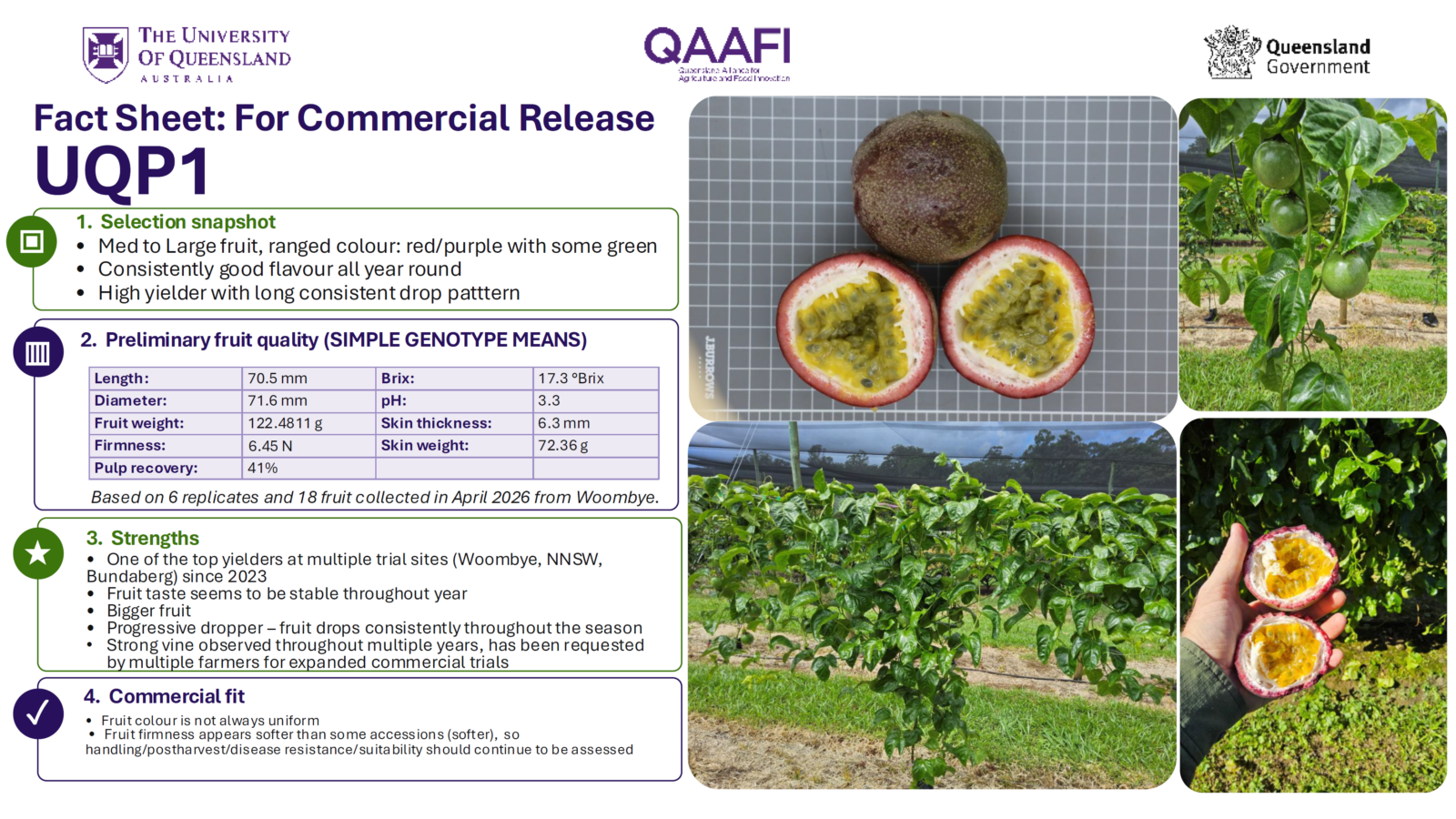
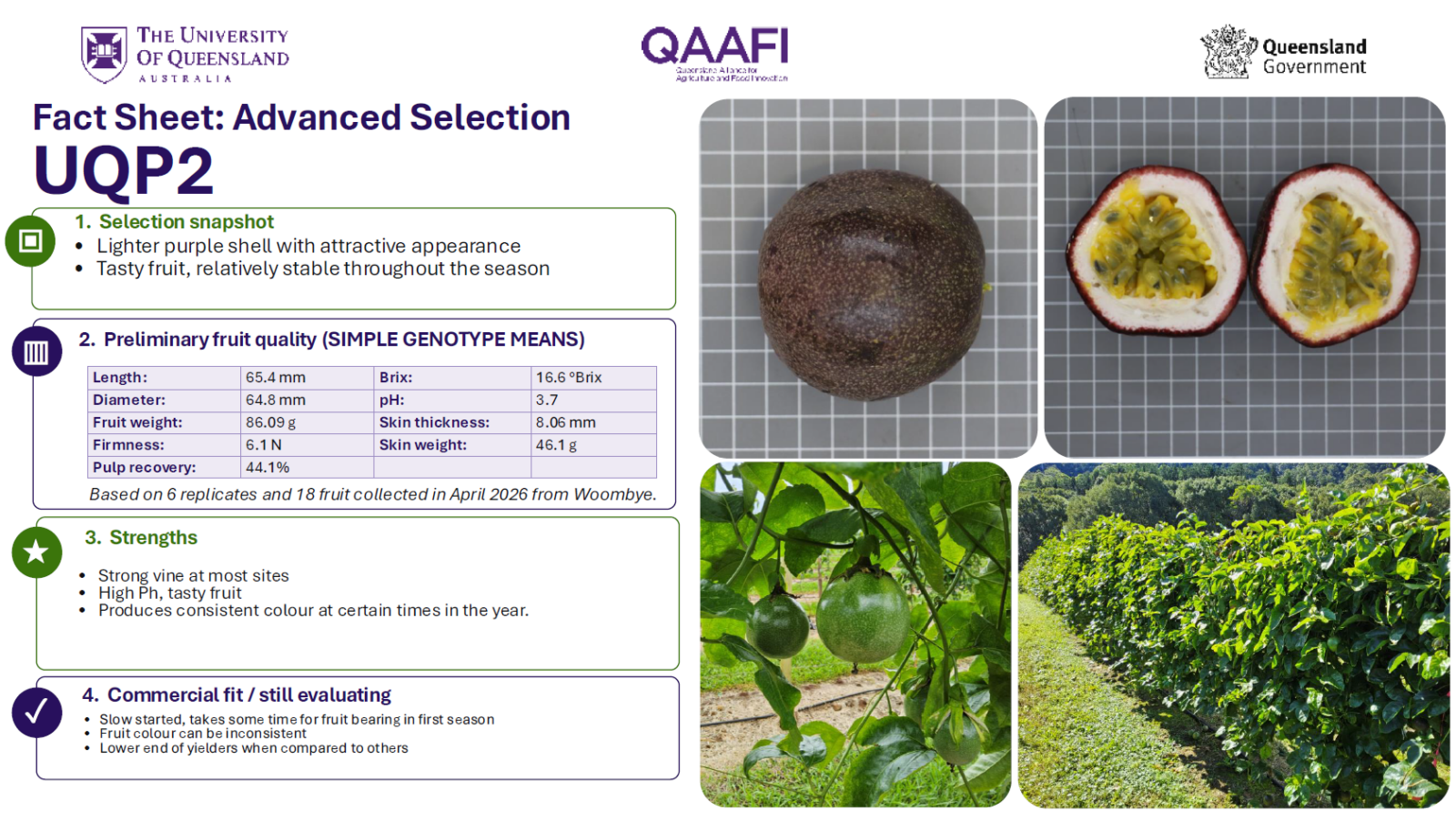
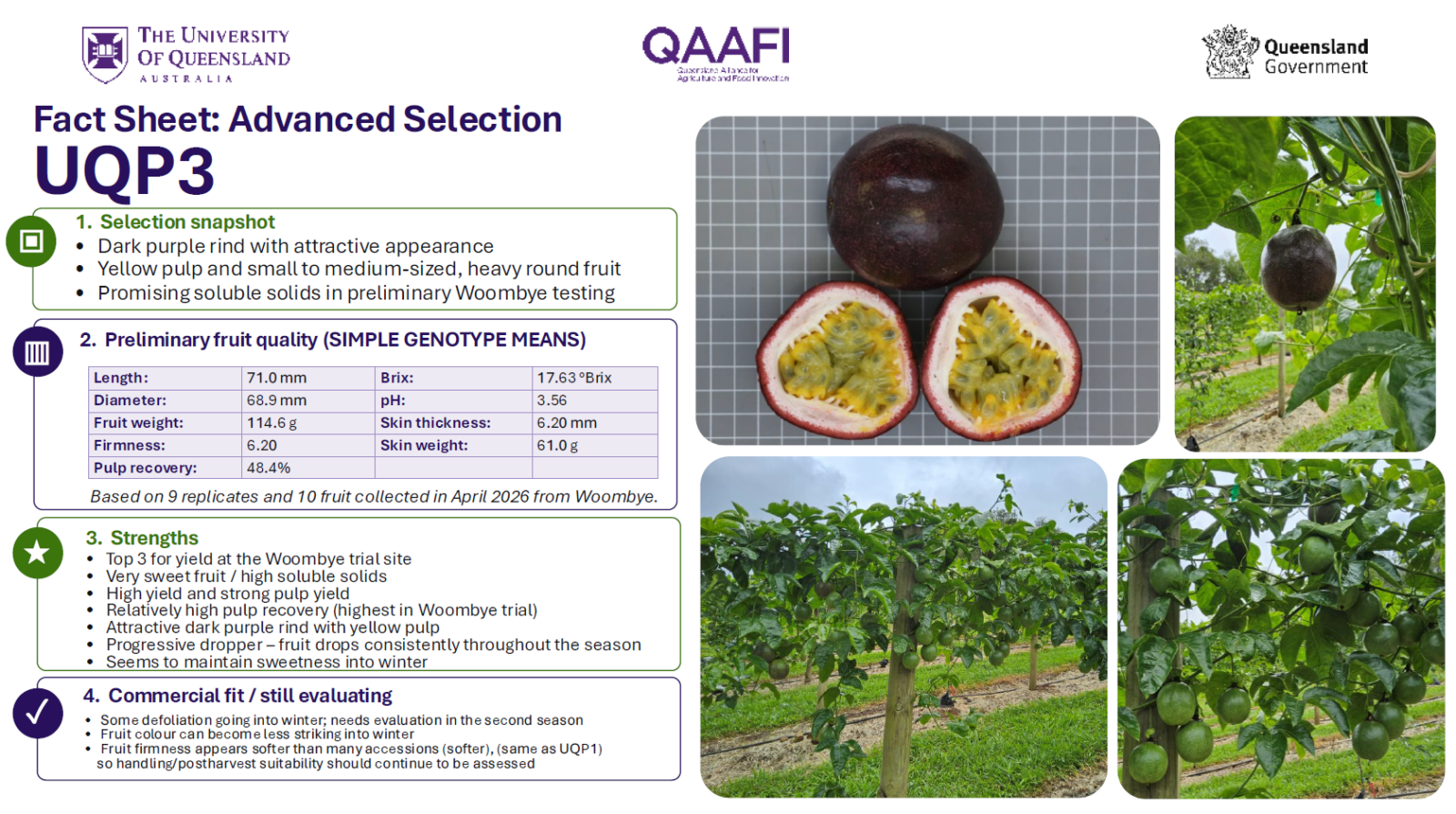
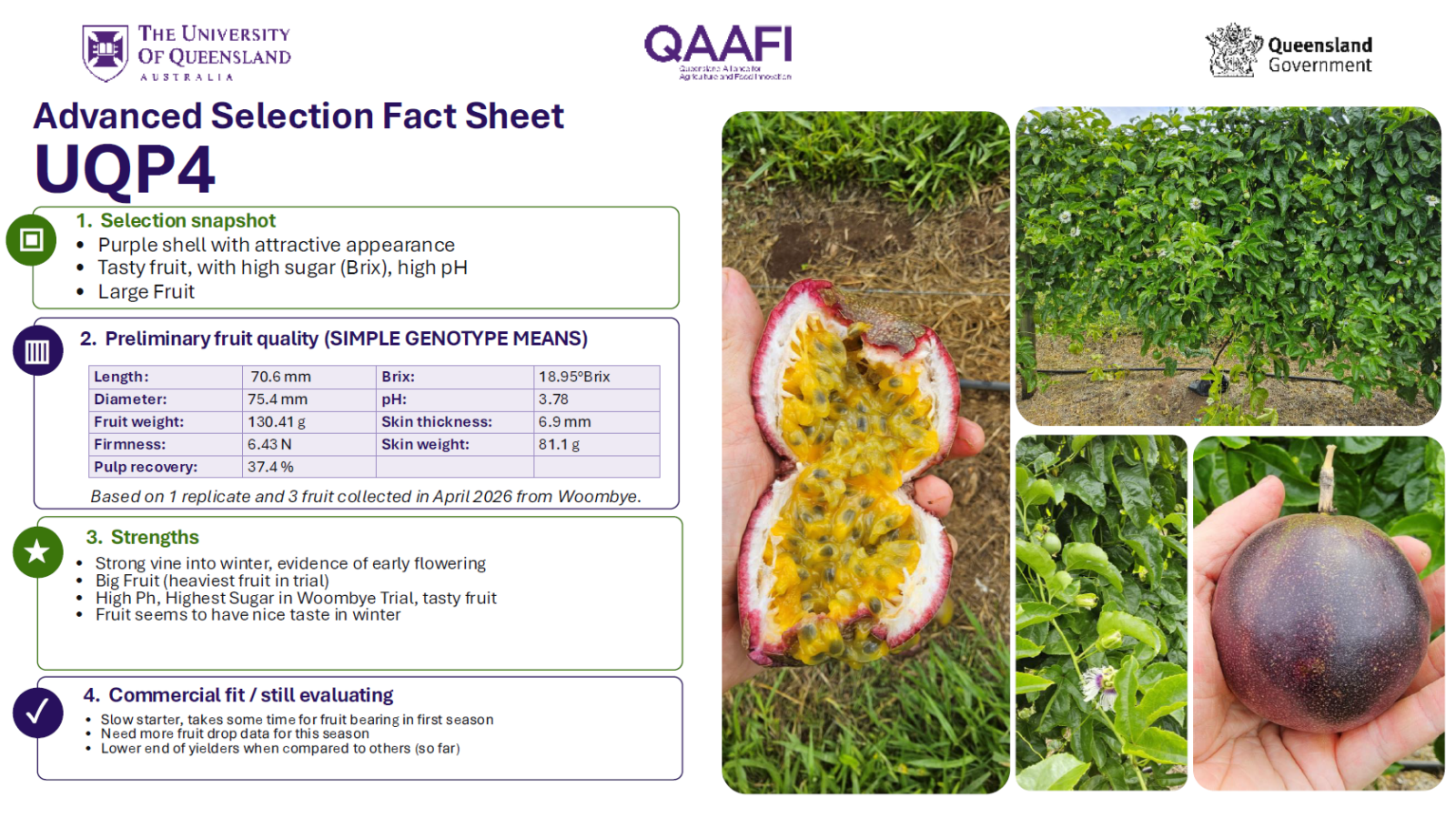
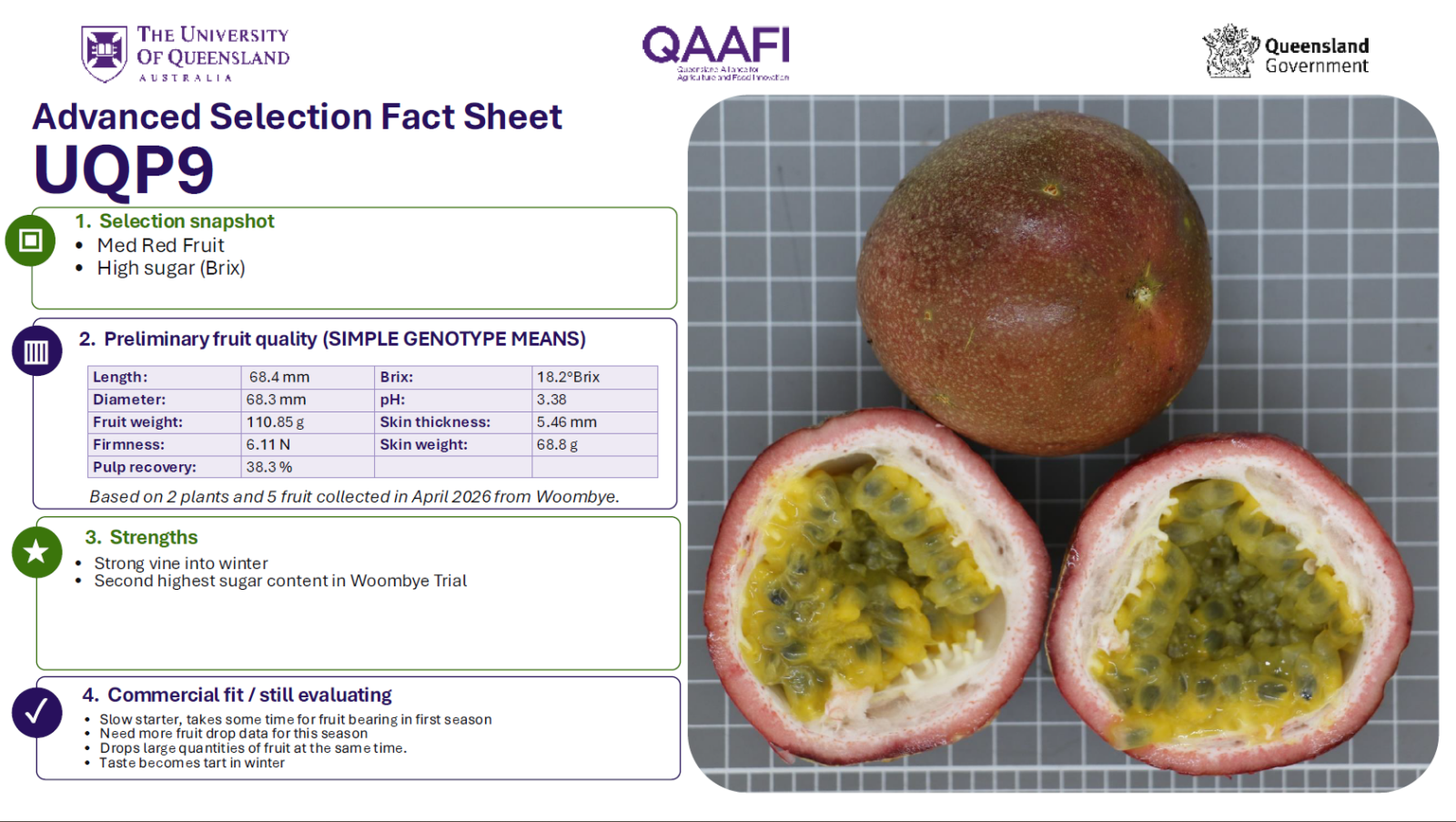
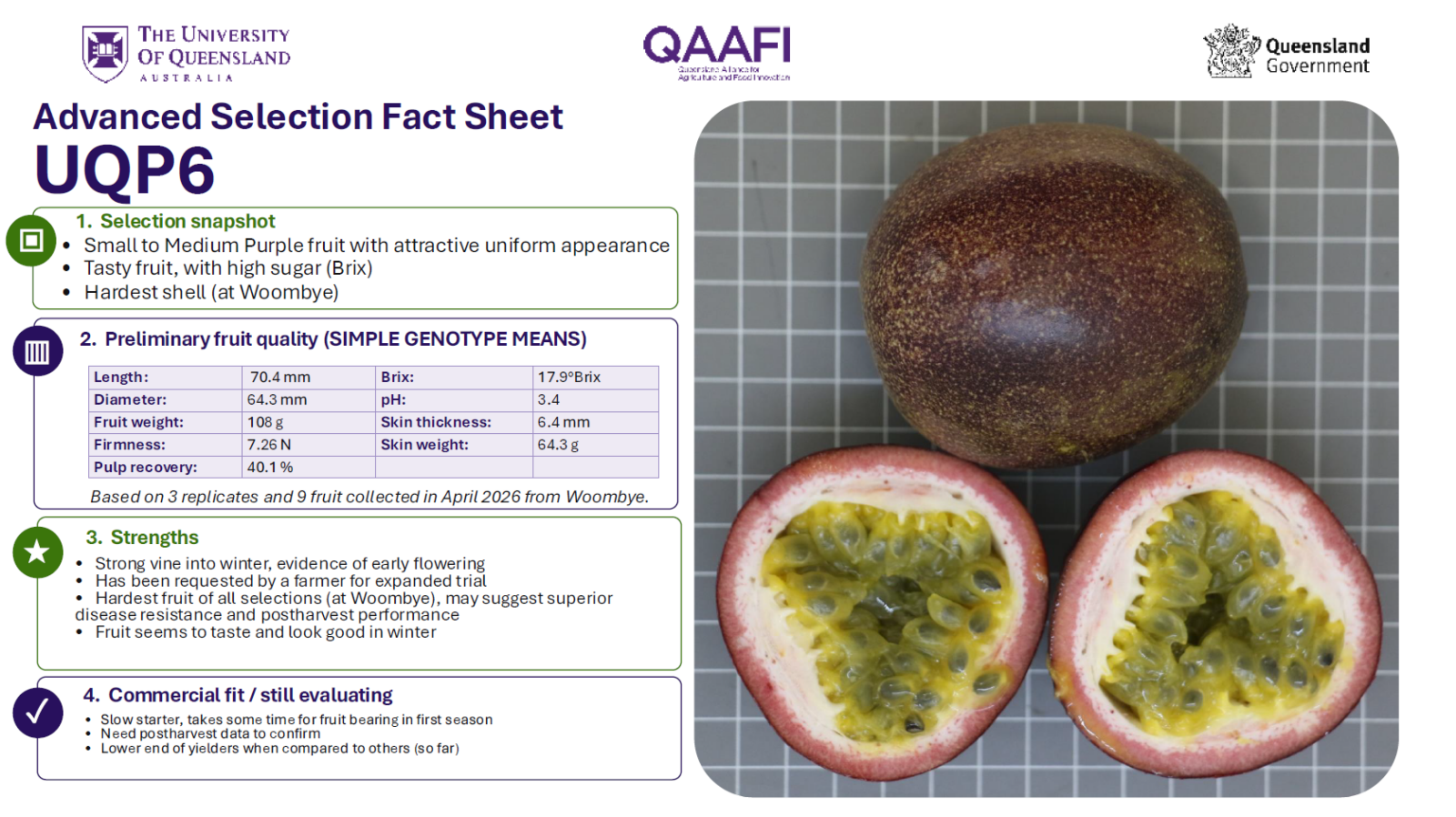
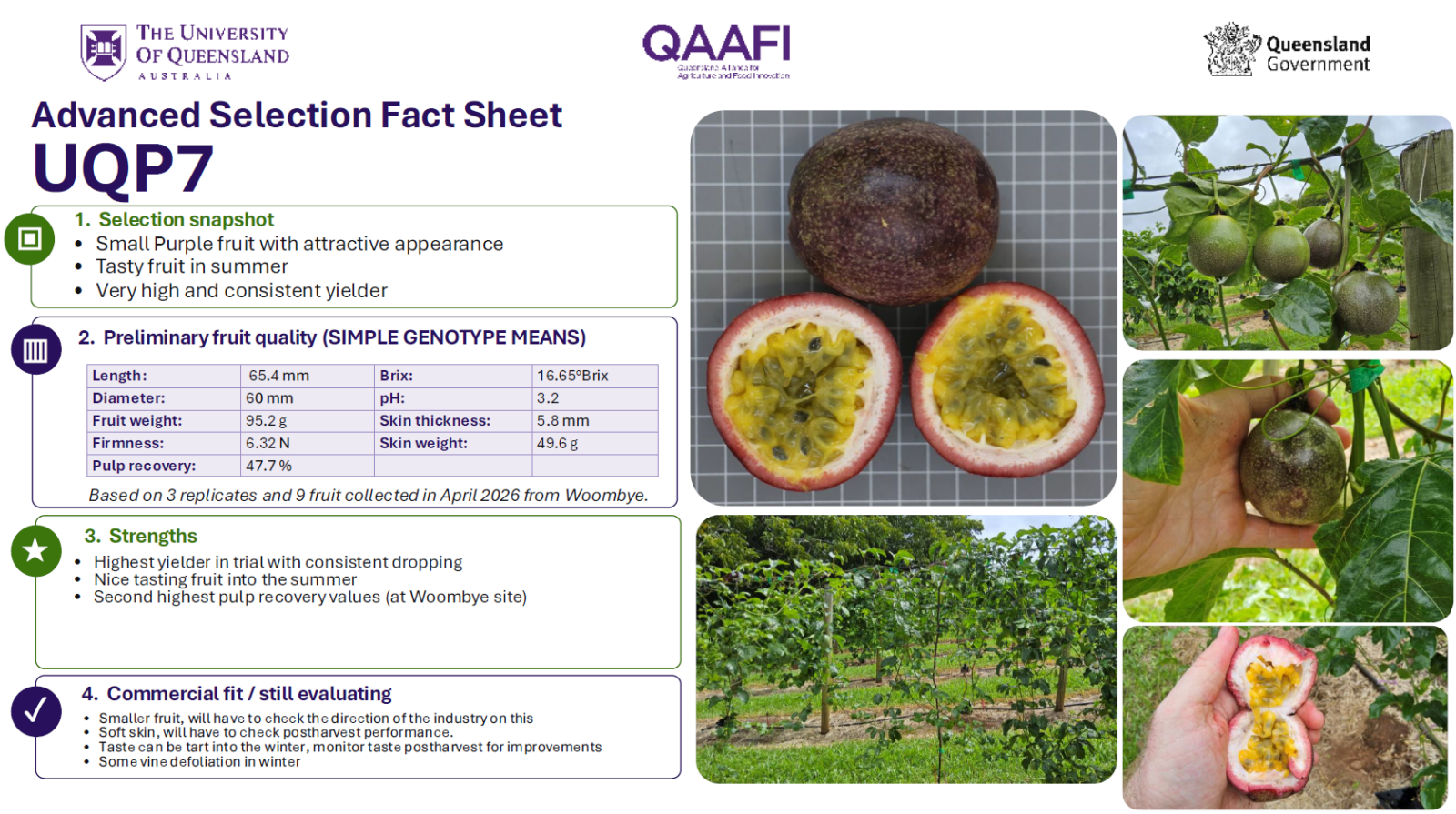
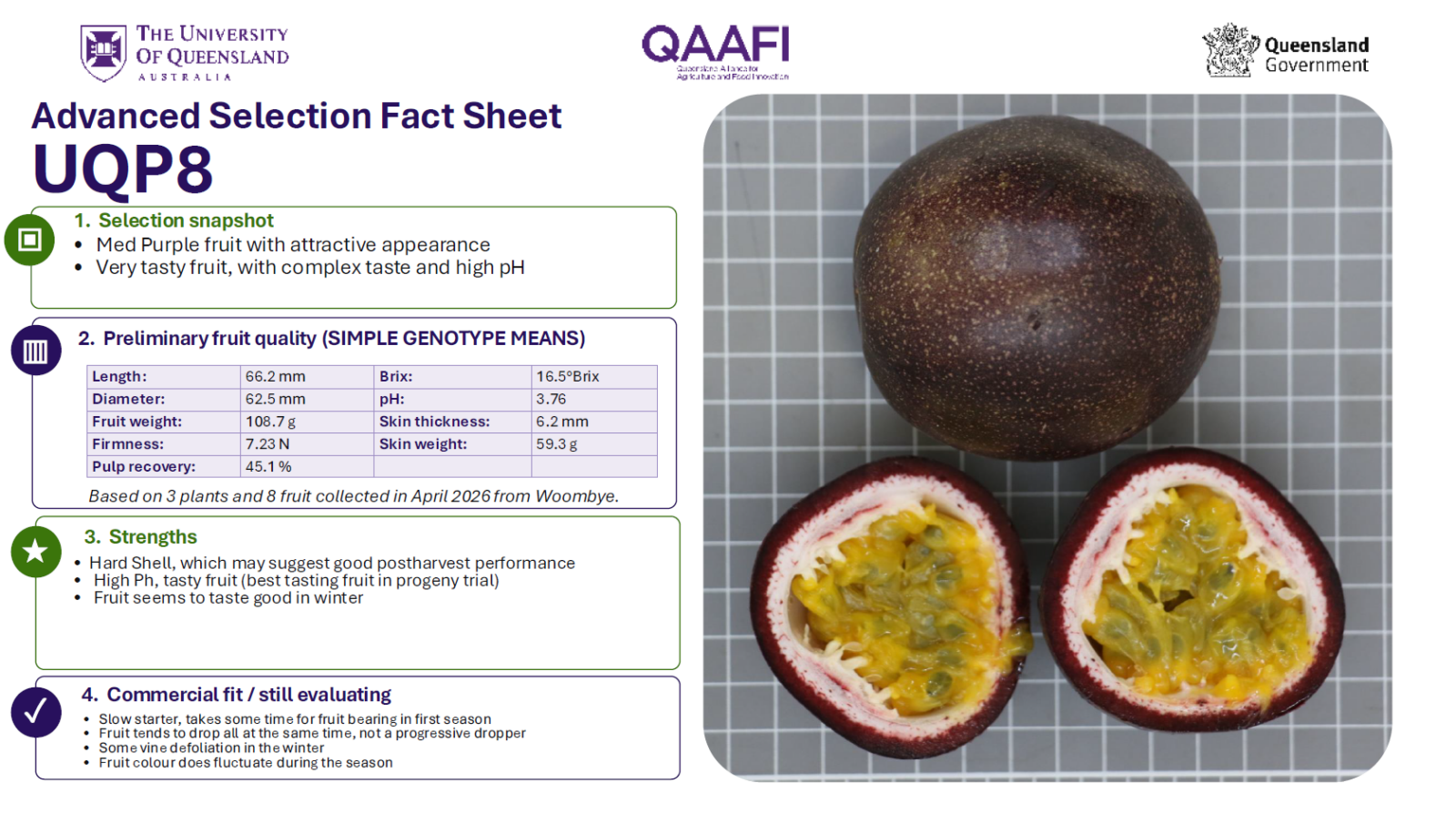
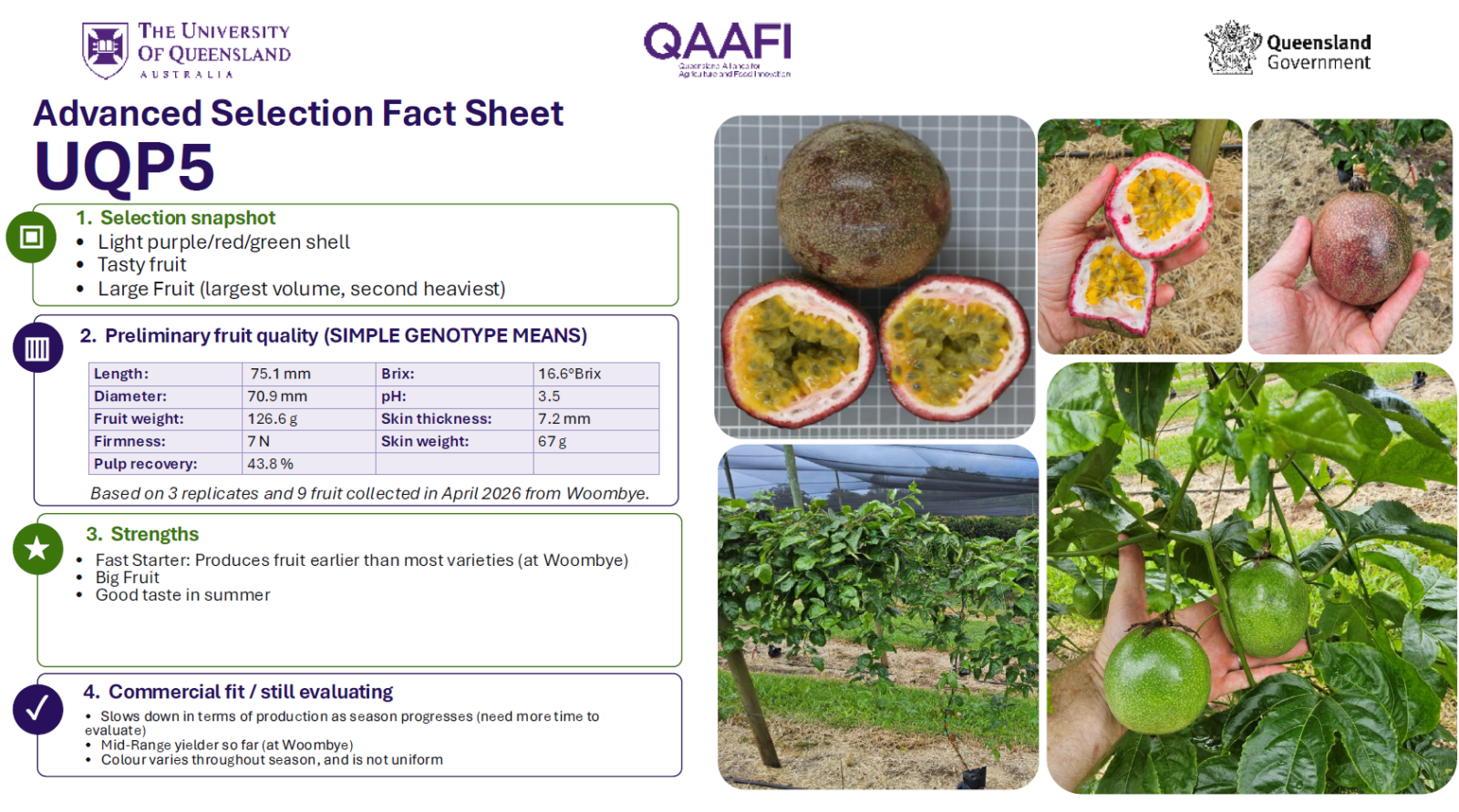
Fact Sheets for Commercial Release – July 2026

Read the latest The Passion Vine

NEWS
 Highlights from the 2024/25 Passionfruit marketing campaign – Hort Innovation17/11/2025 - 12:23 pm
 Growers at the helm: How industry shapes Hort Innovation investments30/09/2024 - 11:59 pm

